
KMP vs Flutter 🧑🏻💻 : Who will win the Cross-Platform battle? 🏆
- nimesh Vasani
- Aug 5, 2024
- 3 min read

Updated: Aug 5, 2024
In the ever-evolving world of mobile app development, the quest for the ultimate cross-platform solution continues. Two major contenders in this arena are Kotlin Multiplatform (KMP) and Flutter. Both offer unique features and promise to simplify the development process, but which one is truly the best? Let's dive into a detailed comparison of KMP and Flutter, exploring their possibilities, key features, and where they stand in the cross-platform battle.

Kotlin Multiplatform (KMP) 🚀
The Kotlin Multiplatform technology is designed to simplify the development of cross-platform projects. It reduces time spent writing and maintaining the same code for different platforms while retaining the flexibility and benefits of native programming.
Native UI and Shared UI :
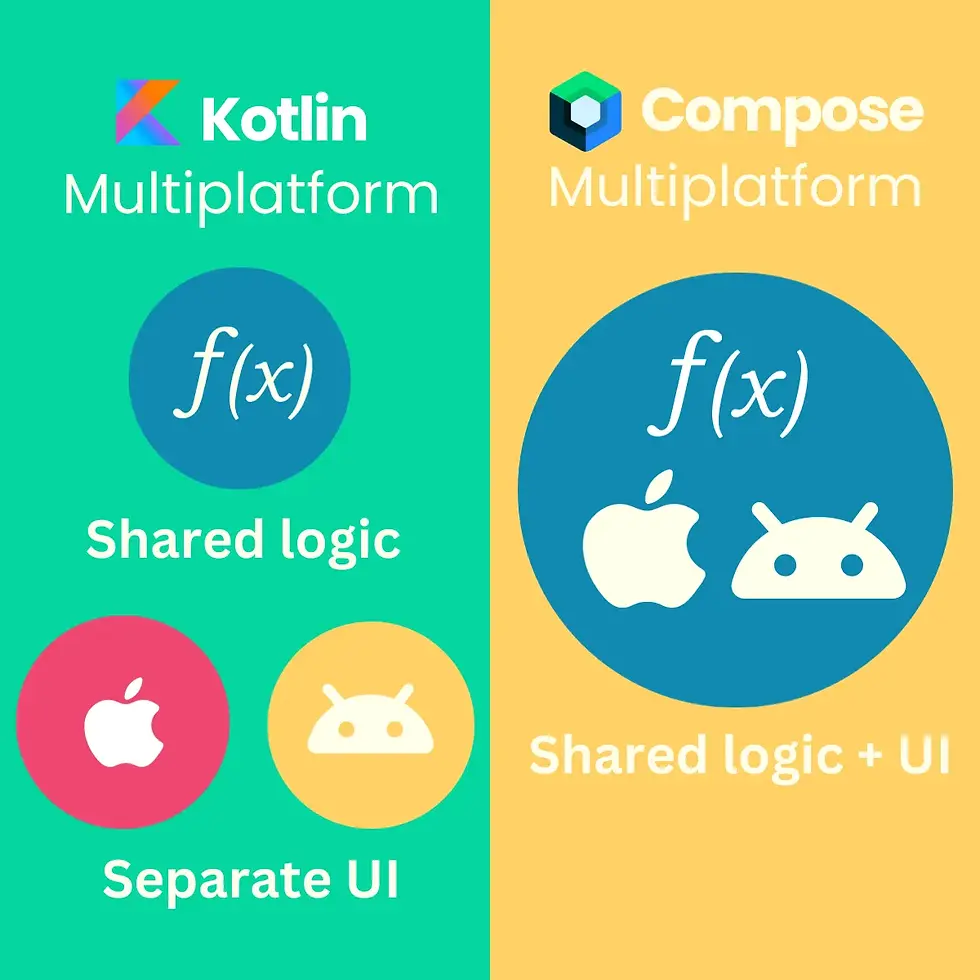
KMP allows developers to write code that can be shared across multiple platforms, including iOS, Android, and more. This includes both business logic and UI components. KMP provides the flexibility to use:
Native UI: Developers can write platform-specific UI code, ensuring that the app looks and feels native on each platform. This is ideal for apps that require a highly customized user experience.
Shared UI: With Jetpack Compose for Android and Compose Multiplatform in beta, developers can write UI code that runs on multiple platforms. This approach reduces duplication and speeds up the development process.
Key Points:
Native Performance: Since KMP allows the use of native components, it ensures optimal performance for each platform.
Code Reusability: A significant portion of the codebase, especially business logic, can be shared across platforms, reducing development time and effort.
Interoperability: KMP seamlessly integrates with existing native codebases, making it easier to adopt gradually.
Flexibility: Developers can choose to share as much or as little code as they want, depending on the project requirements.
Flutter 🌟 👩🏻💻

Single Codebase for All Platforms
Flutter, developed by Google, is a UI toolkit that allows developers to create natively compiled applications for mobile, web, and desktop from a single codebase. Flutter uses the Dart programming language and provides a rich set of pre-designed widgets.
Key Points :
Fast Development: Flutter's hot reload feature allows developers to see changes in real-time, significantly speeding up the development process.
Expressive and Flexible UI: Flutter's widget-based architecture provides extensive customization options and a consistent look and feel across all platforms.
High Performance: Flutter apps are compiled to native code, ensuring high performance on both Android and iOS.
Growing Ecosystem: With a rapidly growing community and extensive library of packages, Flutter is constantly evolving and improving.
KMP vs. Flutter: The Showdown ⚔️
Performance 🏎️
KMP: Offers near-native performance by leveraging platform-specific components. Ideal for performance-critical applications.
Flutter: Also delivers high performance by compiling to native code, but the additional layer of the Flutter engine can sometimes introduce slight overhead.
Development Speed ⏩
KMP: Allows sharing of business logic but requires platform-specific UI development unless using Compose Multiplatform. This can slow down the development of the UI layer.
Flutter: Provides a single codebase for the entire application, including UI, which can significantly speed up development.
UI Flexibility 🎨
KMP: Offers greater flexibility with the choice between native and shared UI, allowing for highly customized native experiences.
Flutter: Provides a consistent UI across platforms with extensive customization options through its widget-based system.
Community and Ecosystem 🌍
KMP: Backed by JetBrains and a growing community. Strong integration with the Kotlin ecosystem and Jetpack Compose.
Flutter: Backed by Google, with a vibrant and rapidly growing community. Extensive library of packages and plugins.
Learning Curve 📚
KMP: Easier for developers already familiar with Kotlin and native Android/iOS development.
Flutter: Requires learning Dart, but the comprehensive documentation and resources make it accessible even for beginners.
Conclusion: Who Wins? 🥇
The answer to this question largely depends on your specific project requirements and team expertise:
Choose KMP if you prioritize native performance, need to integrate with existing native codebases, and prefer Kotlin for development. It's especially suitable for projects that require a high degree of platform-specific customization.
Choose Flutter if you want a single codebase for faster development, a consistent UI across platforms, and access to a rich set of pre-designed widgets. It's ideal for projects that require rapid development and a uniform look and feel.
Ultimately, both KMP and Flutter are powerful tools in the cross-platform development landscape. The best choice will depend on your project's unique needs, your team's skills, and the desired user experience.
Concluded by - Nimesh Vasani
Happy coding! 💻✨


Comments